
A Musing on Fear and the Domestication of the Human Mind
What if the greatest threat facing humanity isn’t a cyberattack, terrorist attacks, WWIII, a nationwide blackout, rogue artificial intelligence, or even an alien invasion?
What if it’s our willingness to believe what frightens us the most?
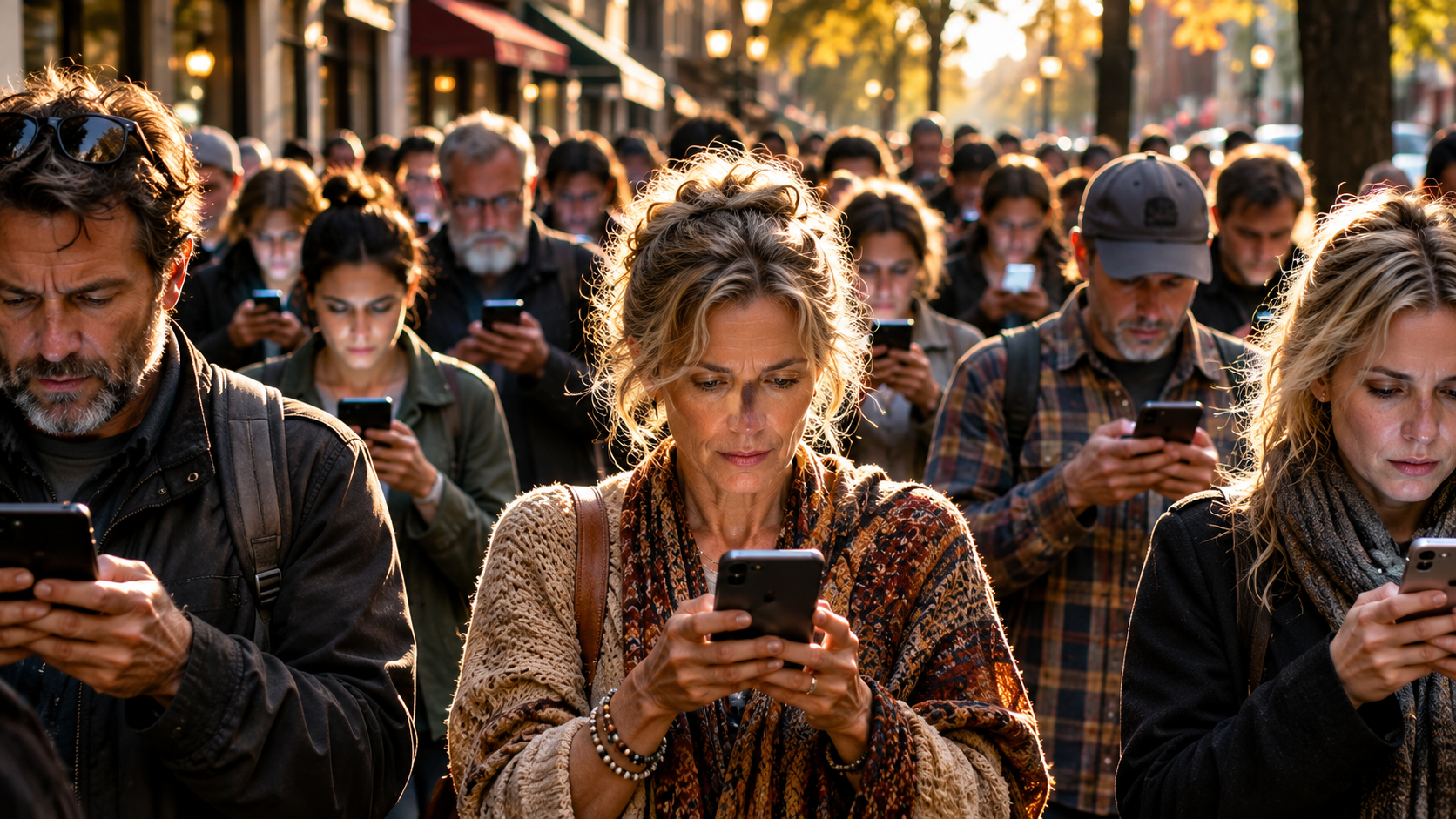
I’ll admit, over the past several days, I’ve seen doomsday headlines escalate, and social media conspiracy theories erupt. They are very seductive. Communication failures, grounded aircraft, banking disruptions, mysterious lights in the sky, military movements, government officials going to safe places, and warnings of prolonged power outages. Depending upon whom you believe, we’re either experiencing an unfortunate series of unrelated events or standing by as something catastrophic occurs.
And apparently, we should all run out and buy generators and 90 days of supplies. Imagine this…how many generators do you think have been sold in the past week? Got PTSD from COVID? Or visions of empty grocery store shelves? I would wager many of us do.
Fear, after all, can be a remarkably profitable business. Just imagine the marketing possibilities. Ninety days without electricity! Better get that generator, stockpile your groceries, fill your gas tanks, and prepare for the apocalypse. And who will win financially from this fear?
Somewhere in the middle of this fiasco, I remembered the 1997 film Wag the Dog, starring Dustin Hoffman and Robert De Niro. The premise is intriguing. To divert attention from a presidential scandal, a political fixer enlists a Hollywood producer to manufacture a war in Albania. With carefully staged images, emotional storytelling, and a cooperative media apparatus, an imaginary conflict becomes a national reality, taking everyone’s attention away from the real scandal.
The public believes what it sees. Or, perhaps more accurately, the public sees what it has been persuaded to believe.
Nearly thirty years later, Hollywood’s elaborate production would seem antiquated. Artificial intelligence can manufacture convincing images, imitate voices, generate eyewitness accounts, and produce endless variations of the same frightening story. Social media can carry those narratives around the world to implant beliefs.
But here’s where things become interesting. What if nobody is directing the production? What if the machinery of persuasion has become so sophisticated, and our participation so automatic, that the spectacle can sustain itself?
In 2004, I pulled together the manuscript for The Toltec Prophecies of Don Miguel Ruiz, drawing together concepts from his teachings and our earlier work, Beyond Fear, published through Council Oak Books. The relevant concept we are dealing with from don Miguel is human domestication.
Ruiz described how human beings are conditioned from childhood through systems of reward and punishment. Parents, teachers, religious institutions, and society introduce us to agreements about who we are, what we should believe, and how we should behave. Eventually, those agreements become so deeply embedded that we no longer require someone else to enforce them. It becomes second nature.
In Beyond Fear, Ruiz used the analogy of a computer receiving information. What we put into the computer determines how it interprets what it encounters. Human beings are much the same. We don’t simply observe the world. We interpret it through the accumulated information, experiences, and beliefs that have shaped our minds. And fear is one of the most powerful influences upon that interpretation.
Now consider the ancient Sophists. In classical Greece, the Sophists taught rhetoric, argument, and the art of persuasion. Although their philosophical traditions were more varied than their critics sometimes acknowledged, the enduring controversy surrounding them concerns a question that remains relevant today: What happens when the ability to persuade becomes more important than the pursuit of truth?
A sophist need not invent an outright falsehood. They can select certain facts, omit others, appeal to emotion, and arrange information so that their audience arrives at the desired conclusion the sophist intended. Better still, the audience believes the conclusion is entirely its own.
The sophist is a subject we explore in my upcoming novel The Field of All Souls, where language, separation, and the manipulation of understanding play important roles. And now, watching the modern news cycle, I find myself wondering whether we’ve created the ultimate sophist.
Not a person standing before a crowd in ancient Athens, but an immense network of algorithms, media outlets, commercial interests, political narratives, and billions of ordinary people worldwide sharing information at extraordinary speed. Because that system works, no single entity is required to manufacture fear.
Fear attracts attention. Attention generates engagement. Engagement produces revenue and influence. The more frightening the story, the more eagerly it travels. And each person who shares it becomes, often quite innocently, another participant in its distribution.
The irony is almost comical. We fear that artificial intelligence may become uncontrollable, while willingly surrendering enormous portions of our attention to systems intentionally designed to anticipate and influence our behavior. We worry that powerful interests may be manipulating our thoughts, while enthusiastically sharing unverified stories that do precisely that. We search for the hidden hand behind every disruption, sometimes overlooking the very real economic and psychological incentives that can turn ordinary uncertainty into extraordinary panic.
And then come the aliens.
Well, at this point, I wouldn’t be surprised to see an extraterrestrial spokesperson appear on television alongside Giorgio Tsoukalos recommending a particular brand of emergency generator. How about you? I wonder if it would be the Grays or the Reptilians?
Of course, humor shouldn’t obscure the distinction between a genuine emergency and a manufactured narrative. Cyberattacks happen. Infrastructure fails. Governments prepare for contingencies. Artificial intelligence presents real challenges. None of this is new.
But possibility is not probability, and speculation is not evidence.
Perhaps that is where discernment begins. The real danger may not be that someone has constructed an elaborate deception, literally wagging the dog, although deliberate deception certainly exists. It may be that we’ve become so accustomed to responding emotionally to information that we seldom examine how it reaches us, who benefits from its circulation, or whether the conclusions we’re drawing are justified.
And here’s the final irony. Even the conviction that everything is orchestrated can become another belief through which we filter reality. Suspicion can domesticate the mind just as effectively as unquestioned obedience. We may spend our lives searching for the person holding our leash, never considering how willingly we follow the tug.
More than twenty years ago, while working with Ruiz’s teachings, I encountered a question that still seems essential: Are we living according to agreements we’ve consciously examined, or are we simply repeating what we’ve been taught to believe?
Today, I would add another. Are we witnessing the world as it is, or as it has been presented to us? Obviously, the singular truth is that fear has been used to control us. Maybe Ruiz was right, and it’s time we move beyond fear.
And that brings me to something far more personal than the headlines. I cannot control the information being disseminated across the world. I cannot determine who speaks the truth, who distorts it, or who profits from the fear it creates. But I can witness what is happening, exercise my own discernment, and choose how I respond. Yes, I’ve put aside some extra water, canned tuna, and chicken. That’s wise. But I can also choose not to flip out over every alarming headline or frightening prediction and that becomes harder to accomplish each day.
And I can choose to pray. Not simply for my own safety, but for everyone caught in the fear of what they’re being told. For those who lie awake worrying about tomorrow, for those who feel powerless against forces they cannot understand, and even for those who may be contributing to the fear.
Here’s my prayer. It’s short and simple:
May God soothe our fears, quiet our minds, and bring us closer. May God’s Grace come into us.
Perhaps that is how we begin to free ourselves from all this mess. Not by controlling the world around us, but by recognizing that we can choose not to allow fear to control our minds. After all, in a world where everyone is shouting that the sky is falling, maybe we ought to look up. And perhaps, before buying another generator, we ought to ask whether the sky is falling at all.

Are YOU Destined to Become a Visionary Writer?
Ja-lene Clark’s The Journey of the Visionary Writer: The Five Phases of Experiential Writing illuminates the path from idea to publication. Filled with brilliant insights and deeply personal stories, this book guides visionaries through the spiritual and emotional complexities of sharing their wisdom. Not a typical how-to, it’s a remarkably advanced, healing, and expansive journey.
Take the leap. Dare to share your wisdom. Purchase your copy today!
Leave a Reply